Collagen supplements: do they work for skin, and are they worth it?
Do collagen supplements work? What the biggest reviews found for skin, why a 2025 analysis disagreed, typical doses, and what to check before you buy.
The short answer
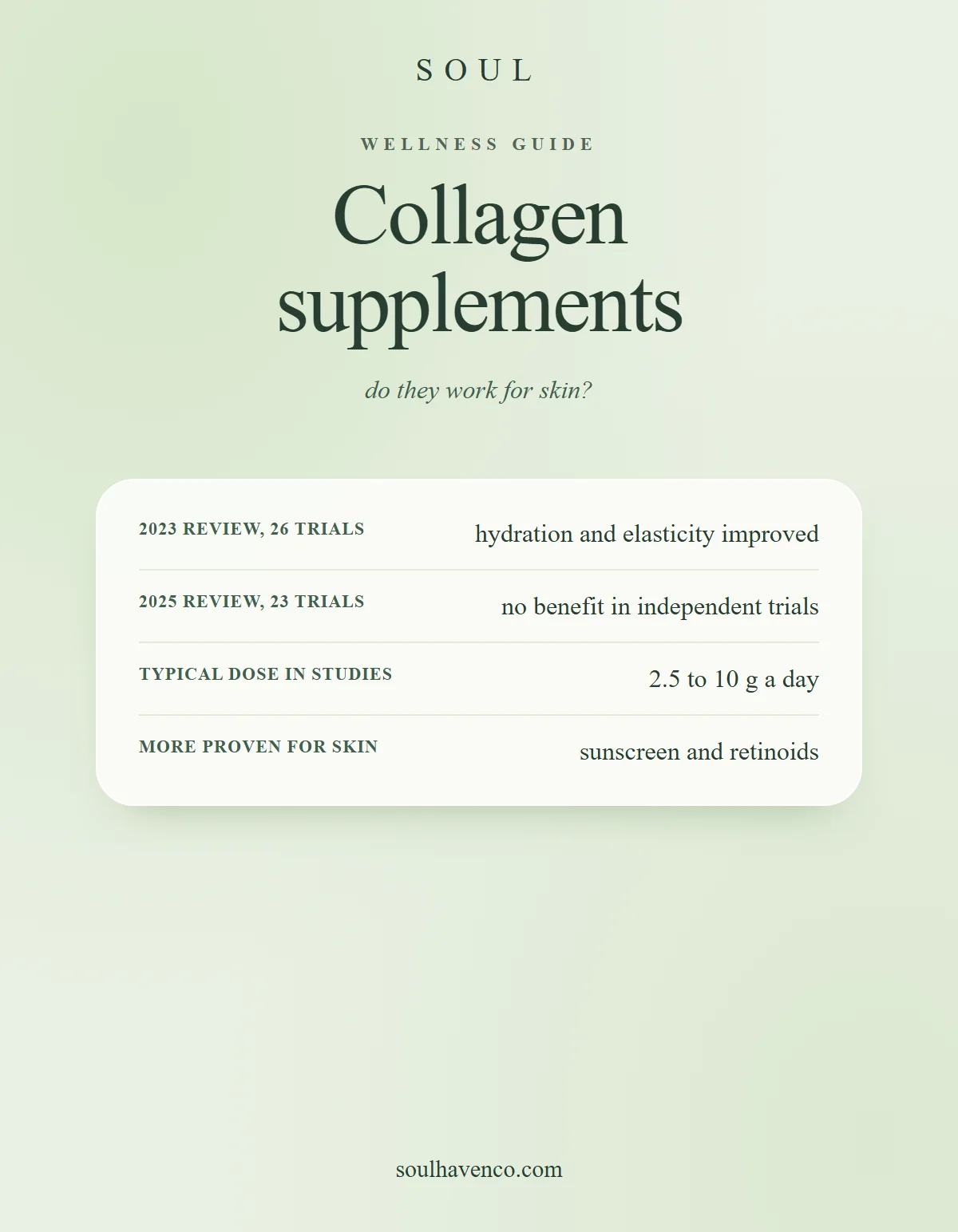
Collagen may modestly improve skin hydration and elasticity, but the evidence is mixed. A 2023 review of 26 trials found benefits; a 2025 review found none in independent or high-quality trials. Studies mostly used 2.5 to 10 grams a day for weeks to a few months.
- Sunscreen, retinoids and enough protein are more proven for skin; look for third-party testing if you buy.
Collagen supplements may modestly improve skin hydration and elasticity, but the evidence is more mixed than the marketing suggests. A 2023 review of 26 trials found benefits for both. A 2025 review found that the benefits disappeared when it looked only at higher-quality trials or trials not funded by industry. Most studies used 2.5 to 10 grams a day for a few weeks to a few months. Here is what that means if you are deciding whether to buy them.
General information, not medical advice. Ask a doctor before taking supplements if you are pregnant, have a medical condition or take medicines.
What are collagen supplements?
Collagen is the most abundant protein in the body, and your own production declines with age. Supplements are usually "hydrolyzed collagen" or "collagen peptides": collagen broken into smaller pieces, sold as powders, capsules and drinks, mostly from cow hide or fish skin. Food sources such as bone broth and chicken, fish or pork skin provide some collagen, but not much, according to Harvard Health.
Do collagen supplements work for skin?
The two largest recent reviews disagree, and the reason they disagree is the useful part:
| Review | What it included | What it found |
|---|---|---|
| Pu et al., Nutrients, 2023 | 26 randomized trials, 1,721 people | Hydrolyzed collagen improved skin hydration and elasticity compared with placebo; the authors called for larger trials |
| Myung and Park, American Journal of Medicine, 2025 | 23 randomized trials, 1,474 people | Overall gains in hydration, elasticity and wrinkles, but no benefit in trials without industry funding or when only high-quality trials were analyzed |
| Harvard Health, June 2025 | A doctor's summary of the research | Some evidence for skin elasticity, hair and nails, joint pain and bone density, but research is still early |
The 2025 review is summarized from NutraIngredients' report, which also covers the supplement industry's objections to it.
The 2023 review found real effects across its trials, but noted that several had fewer than 40 participants, used different products and doses, and some relied on self-reported measures. The 2025 review pointed out that most trials were funded by companies selling collagen, and that the independent ones showed no benefit. Industry groups disputed its methods, and a later review reported improvements in hydration and elasticity but not in wrinkles.
A fair summary: collagen may give a small improvement in skin moisture and bounce for some people, it has weak evidence for wrinkles, and the best-designed independent trials are not convinced.
Collagen for hair, nails and joints
Harvard Health says there is some evidence that collagen may strengthen hair and nails and reduce joint pain, and that taken with strength training it may help build muscle, but that the research is still early and large studies are needed. If hair is your main concern, start with the causes; if it is your nails, our guide on why nails peel and split covers what helps.
How much collagen to take, and for how long
In the 2023 review, most trials used about 2.5 to 10 grams a day, and studies ran for roughly 2 to 16 weeks. There is no official recommended dose. If you try it, follow the label, give it a couple of months, and judge it honestly against how your skin looked before.
Collagen vs eating enough protein
Your body breaks collagen down into amino acids during digestion and uses them wherever it needs protein, so a collagen powder is, at the least, a protein supplement. Collagen is not a complete protein, though, so it does not replace a varied diet. Eating enough protein overall, plus vitamin C, which the body needs to make collagen, is the foundation.
Types of collagen, and marine vs bovine
Labels often list collagen "types". Type I is the main collagen in skin, so skin products usually contain types I and III. Type II is the collagen in cartilage, which is why it shows up in joint supplements. Hydrolyzed collagen is broken into peptides whatever its type.
Bovine collagen comes from cow hide; marine collagen comes from fish skin and scales. Neither has been clearly shown to work better for skin. Choose based on your diet and allergies: marine collagen is not suitable if you are allergic to fish, and neither is vegan. "Vegan collagen" products contain ingredients meant to support your own collagen, not collagen itself.
Who should be careful
Collagen is generally well tolerated, but check the source if you have fish or other food allergies, and look at the whole label, since many powders add sweeteners, vitamins, biotin or caffeine. If you are pregnant, breastfeeding, have kidney disease or take medicines, ask a doctor first, as you would with any supplement.
What helps skin more reliably
- Daily sunscreen. Sun damage breaks down collagen, so protecting what you have is the most proven step.
- A retinoid at night. Our guide to retinal vs retinol explains the options.
- Topical peptides, with their own evidence base: see peptides for skin.
- Not smoking, sleeping well and eating enough protein.
If you buy collagen supplements
- Check the dose per serving in grams and compare it with the 2.5 to 10 gram range used in studies.
- Look for third-party testing, such as a USP or NSF mark. In the US, supplements are not approved by the FDA before sale.
- Check the source (bovine, marine) if you have allergies or dietary rules; marine collagen comes from fish.
- Be wary of big claims. "Reverses aging" and "clinically proven" are marketing, not evidence.
Questions people ask about this
Do collagen supplements work?
They may modestly improve skin hydration and elasticity. A 2023 review of 26 trials found benefits, but a 2025 review found no benefit in independent or high-quality trials, so the evidence is mixed.
What are collagen supplements good for?
The best evidence is for skin hydration and elasticity. Evidence for hair, nails, joints and bones is early, according to Harvard Health. Evidence for wrinkles is weak.
How much collagen should I take a day?
Most studies used about 2.5 to 10 grams of hydrolyzed collagen a day. There is no official recommended dose, so follow the label.
How long does collagen take to work?
Studies ran from roughly 2 to 16 weeks. Give it a couple of months before judging.
Are collagen peptides the same as hydrolyzed collagen?
Yes, the terms are used for collagen that has been broken into smaller pieces so it dissolves easily.
Is it better to get collagen from food?
Food such as bone broth and fish or chicken skin provides some collagen, but not much. Eating enough protein and vitamin C overall supports your body's own collagen.