Aviator sunglasses: how to choose a pair that suits your face
Aviator sunglasses suit more faces than most shapes, at the right size. Which face shapes, what lens width, UV400, nickel and lens colour to choose.
The short answer
Aviators are slim metal teardrop sunglasses developed for pilots in the 1930s; they suit square, heart, oval and long faces. Size decides the look: lens widths run about 55 to 62 mm, and the frame should be about as wide as your face. Protection comes from a UV400 marking, not from the shape; polarization is a separate glare filter.
- Metal frames and nose pads can contain nickel, so choose titanium, stainless steel or plastic pads if your skin reacts.
Aviator sunglasses are the teardrop-shaped, thin-framed style that began as pilot gear and has stayed in fashion for more than eighty years. They flatter more faces than most shapes, but only at the right size, and the details that matter are the width of the lens, the nose pads and the metal in the frame. Here is how to choose a pair that suits you and holds up.
What are aviator sunglasses?
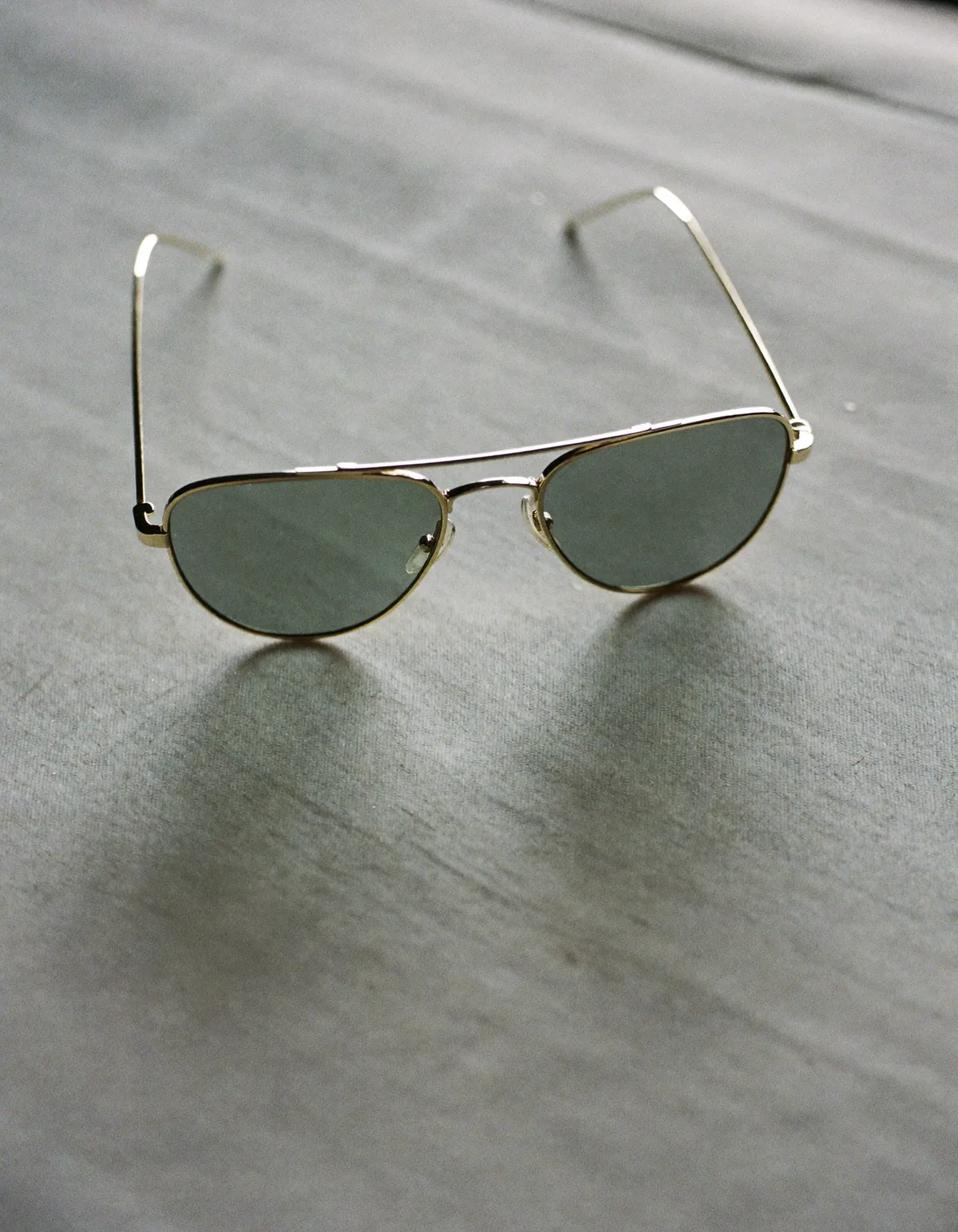
Aviators have a slim metal frame, large teardrop lenses that are wider at the top than the bottom, a double bridge and adjustable nose pads. The shape was developed in the 1930s for pilots, with large lenses to cover the eye and reduce glare from above. The design was released to the public soon afterwards and has returned in the fashion cycle ever since, in metal, plastic and mixed versions.
What face shapes do aviator sunglasses suit?
Aviators work by contrast, the rule that explains why some shapes suit some faces. They have a curved lower edge and a straight brow bar, so they soften angular faces and add structure to softer ones. In general they suit square, heart, oval and long faces well. Round faces can wear them if the frame is fairly angular and the lens not too round; very small, round-lensed aviators repeat the face and disappear into it. Our guide to glasses for your face shape explains the rule in detail.
| Face shape | Aviator advice | What to watch |
|---|---|---|
| Square | Teardrop lenses soften a strong jaw | Avoid very boxy, flat-topped variants |
| Heart | Wider top, narrower bottom echoes the face; keep the frame light | Heavy top bars add to a broad forehead |
| Oval | Most sizes work | Keep the frame about as wide as your face |
| Long | Larger, deeper lenses shorten the look of the face | Small, narrow aviators lengthen it |
| Round | Choose a more angular, squarer-lens version | Small round lenses repeat the face |
| Diamond | Detail on the brow line and a slightly softer lens works | Narrow frames across the cheekbones |
A starting point, not a verdict: fit overrides every row.
What size aviator sunglasses should you buy?
Size decides whether aviators look right. Aviators are commonly sold in widths of around 55 to 62 mm per lens, and the frame should be about as wide as the widest part of your face, no wider. Too wide and the glasses look borrowed and slide; too narrow and they pinch. The three numbers printed inside the arm, such as 58-14-135, give lens width, bridge width and arm length, so copy them from a pair that fits, as in our fit guide. Your eyes should sit slightly above the vertical centre of the lens.
Do aviator sunglasses protect your eyes?
They protect only as much as the lens does, and the marking that counts is UV400. The large lens covers more of the eye area than a small frame, which helps with light coming in around the edges, but coverage is not protection from UV. Look for UV400 on the tag, and read UV400 sunglasses: how to buy a pair for what to check. If you want less glare on water or the road, a polarized lens helps; see polarized sunglasses: what they do.
What should you check in the frame and nose pads?
- Metal and skin. Metal frames and nose pads can contain nickel, the most common contact allergen. If your skin reacts to jewelry, choose titanium or stainless steel frames labelled nickel-free, or plastic pads. See our nickel allergy guide.
- Adjustable nose pads. Pads you can bend let a metal frame sit comfortably on a low or wide bridge.
- Hinges. Spring hinges, or well-set standard ones, are what hold up past a year.
- Lens material. Glass scratches less; plastic lenses are lighter. Both can be UV400.
Which lens colour suits aviators?
The classic is a gray-green or gray lens, which keeps colours true and works for driving. Brown gives more contrast in variable light, and a gradient (dark at the top, lighter below) shades the sky while keeping a dashboard readable. Mirror coatings reduce glare further at altitude and on water. Our buying guide has the full tint table.
Where to find aviator-style sunglasses at a lower price
Aviators are widely available from designer labels at high prices and from direct-to-consumer brands at much lower ones. The features that matter, UV400, fit and a frame that does not irritate your skin, do not depend on price. If you prefer a different shape, Dima Eyewear sells cat-eye and oval sunglasses with polarized lens options; it is a SOUL partner, and we earn a commission if you buy through our link. Whichever brand you choose, check the UV400 marking and the measurements before you order.
Read next: Do Blue Light Glasses Work? What the Trials Found
Questions people ask about this
What face shape suits aviator sunglasses?
Square, heart, oval and long faces suit aviators well. Round faces can wear a more angular version, and the frame should be about as wide as your face.
What size aviator sunglasses should I get?
Aviators are commonly sold in lens widths around 55 to 62 mm. Choose a frame about as wide as the widest part of your face, and copy the three numbers inside the arm from a pair that fits.
Do aviator sunglasses have UV protection?
Only if the lens is marked UV400. The shape and the large lens do not by themselves protect your eyes from UV.
Are metal aviator frames bad for nickel allergy?
They can be, since metal frames and nose pads may contain nickel. Choose titanium or stainless steel frames labelled nickel-free, or plastic nose pads.
What lens colour is best for aviators?
Gray or gray-green is the classic and keeps colours true. Brown adds contrast in variable light, and a gradient helps with driving.