Glasses and your face shape: one rule explains every chart
Face-shape charts contradict each other constantly. One contrast rule explains all of them at once — and two measurements matter more than your shape does.
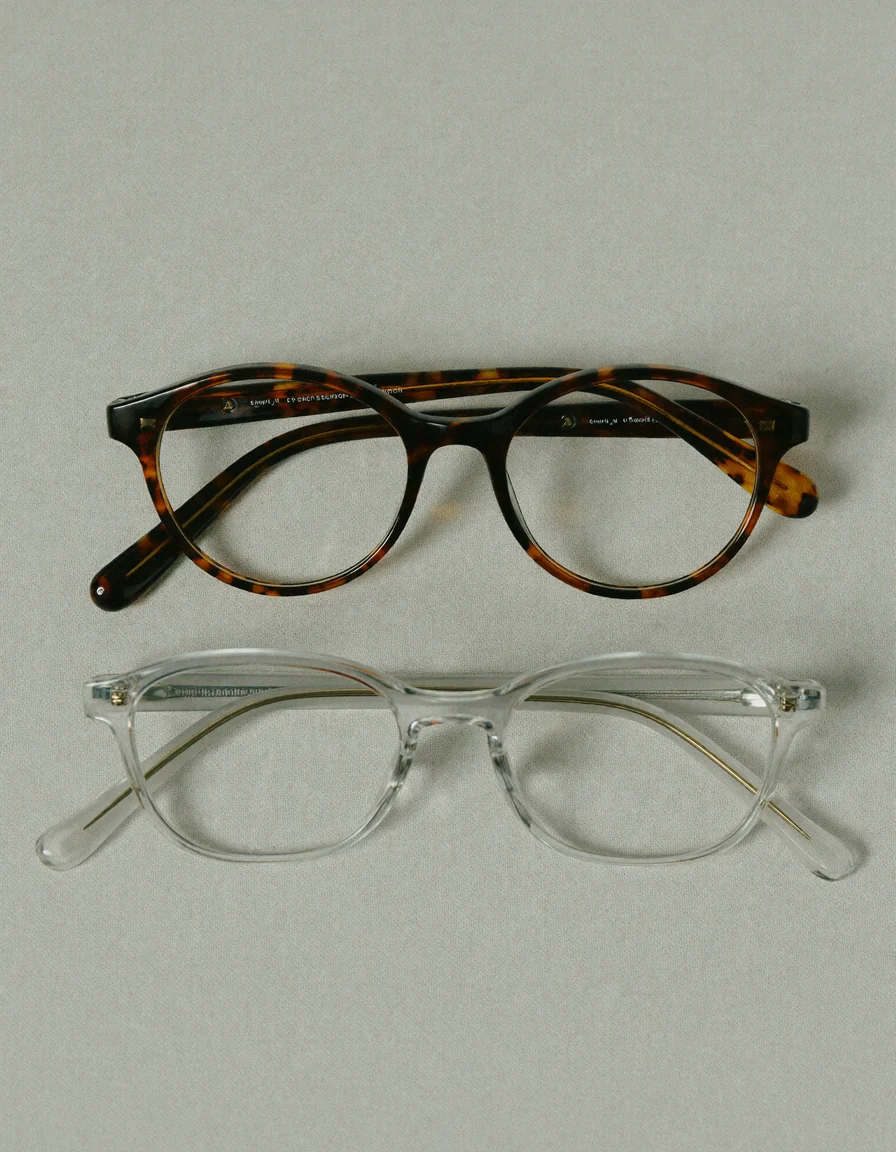
Search this and you will find a dozen charts that disagree with each other. One says round faces need angular frames; the next puts a round face in round frames. They cannot all be right, and the reason they conflict is that they are all restating one underlying idea badly.
The rule underneath every chart
Frames work by contrast. A frame that repeats the shape of your face disappears into it; a frame that opposes it reads as deliberate. That is the whole principle, and every face-shape chart is a partial translation of it.
So: softer, rounder faces are flattered by frames with defined corners, and angular faces are softened by curves. Not because one shape is better, but because difference is what the eye registers as structure.
The second half of the rule, which charts leave out: the frame should echo your brow line. The top bar of a frame reads as a second eyebrow. When the two run roughly parallel the whole thing looks intentional; when they fight, something looks off in a way people struggle to name.
The two measurements that matter more than shape
Fit beats shape, and almost nobody checks either of these.
Frame width against face width. The frames should be about as wide as the widest part of your face, and no wider. Too wide and the face looks narrow and the glasses look borrowed; too narrow and they pinch and slide. If the arms bow outwards to reach your ears, they are too small — and that pressure is a headache by mid-afternoon.
Where your eyes sit in the lens. Your pupils should sit slightly above the vertical centre of the lens and roughly centred horizontally. Eyes sitting low in the frame is the single most common reason a pair looks wrong on someone, and it cannot be fixed by adjustment.
Two more that decide comfort: the bridge must sit on your nose without gapping or pinching — a low or wide bridge needs frames made for it rather than pads bent inwards — and the arms should touch your head only at the ears, not grip the sides.
| If your face is | It reads as | Frames that work |
|---|---|---|
| Round | Soft, similar width and length | Rectangular, square, defined corners |
| Square | Strong jaw, angular | Round, oval, soft edges |
| Oval | Balanced proportions | Most things — keep width honest |
| Heart | Wider forehead, narrow chin | Bottom-heavy, rimless lower, light on top |
| Long | Longer than wide | Deeper lenses, decorated or low temples |
| Diamond | Wide cheekbones | Detail on the brow line, cat-eye, oval |
Use this as a starting point, not a verdict. The fit checks above override every row of it.
Colour, briefly and usefully
The same undertone logic that decides foundation decides frames. Cool undertones sit well with silver, black, grey, blue and rose; warm undertones with gold, tortoiseshell, warm brown, olive and honey. If you are unsure which you are, the forearm-vein check in how to match a foundation shade is the same test and takes ten seconds.
Beyond that: a frame close to your hair colour reads as quiet, and a frame that contrasts with it reads as a feature. Both are legitimate, but decide which you are doing.
What to ignore
“Determine your face shape” exercises with a mirror and a bar of soap. Most faces are a blend, the categories have soft edges, and people routinely mis-sort themselves — then buy against a category they were never in. If you must classify, take a straight-on photo with your hair back and neutral expression, and judge the outline rather than your opinion of your own face.
Also ignore anything implying a shape forbids a style. The contrast rule explains why some combinations are easier, not which are allowed.
Buying online without trying them on
Get the numbers off a pair you already own and like. They are printed on the inside of the arm or the bridge, as three figures: lens width, bridge width and arm length — for example 52-18-140. Lens width and bridge width added together give roughly the front width, which is the number that decides whether a frame fits at all.
Virtual try-on is useful for colour and rough proportion and unreliable for fit, because it cannot see your bridge or how far your ears sit back. Treat it as a shortlist tool. And if you are ordering more than one pair to compare, order the same style in two widths rather than two styles in one width — width is what you cannot judge from a photograph.
One last thing worth separating out: the lens and the frame are different decisions. If you came here from screen-fatigue advice, the evidence on what a tinted lens does is in do blue light glasses work, and the one sunglasses specification that actually protects your eyes is in how to buy sunglasses.
Questions people ask about this
How do I know which glasses suit my face shape?
Frames work by contrast: a frame that repeats your face's shape disappears into it, and one that opposes it reads as deliberate. Softer, rounder faces suit defined corners; angular faces suit curves. The frame's top bar should also run roughly parallel to your brow line.
What matters more than face shape when choosing glasses?
Fit. The frames should be about as wide as the widest part of your face and no wider, and your pupils should sit slightly above the vertical centre of the lens. Eyes sitting low in the frame is the most common reason a pair looks wrong, and no adjustment fixes it.
How do I find my frame size for buying glasses online?
Read the three numbers printed inside the arm or bridge of a pair you already like — lens width, bridge width and arm length, for example 52-18-140. Lens width plus bridge width gives roughly the front width, which is what decides whether a frame fits.
Should glasses match my hair colour?
Either approach works, but decide which you are doing: a frame close to your hair colour reads as quiet, and one that contrasts reads as a feature. For the frame colour itself, cool undertones suit silver, black, grey and rose; warm undertones suit gold, tortoiseshell and warm brown.
Is virtual try-on accurate for glasses?
It is useful for colour and rough proportion and unreliable for fit, because it cannot see your bridge shape or how far back your ears sit. Use it to build a shortlist, then decide on the printed measurements.