What colors look good on me? Find your best colors in three steps
Find the colors that suit you in three steps: undertone, value and chroma. The best colors for all 12 seasons, a two-minute mirror test and what to wear when.
The short answer
The colors that suit you match your undertone (warm or cool), value (light or deep) and chroma (bright or soft). Your strongest trait names your color season; the table gives each season's best colors, metal and colors to skip.
- Check any color by holding it under your chin in daylight beside another one.
The colors that look good on you are the ones that match three things about your natural coloring: whether it is warm or cool, light or deep, and bright or soft. Get those three right and a color makes your skin look even, your eyes clearer and any shadows softer; get them wrong and the same color makes you look tired. This guide walks through the three steps, shows the best colors for each of the twelve color seasons, and gives you a two-minute mirror test to check any color on yourself.
Step 1: are you warm or cool?
Undertone, the cast beneath your skin, is the first question. Warm coloring has a golden or peachy cast and looks best in yellow-based colors such as cream, camel, coral and olive. Cool coloring has a pink or rosy cast and looks best in blue-based colors such as pure white, navy, berry and emerald. If neither wins, you are neutral. Our guide to finding your skin undertone has a five-question test.
Step 2: are you light or deep?
Value is how light or dark your overall coloring is: hair, skin and eyes together. Light coloring, such as fair skin with light hair, is overwhelmed by very dark colors and looks best in lighter shades. Deep coloring, such as dark hair and eyes, can carry dark, rich colors that would swamp lighter coloring. A quick check: squint at a black-and-white selfie. If the photo looks mostly pale, you lean light; if it looks mostly dark, you lean deep.
Step 3: are you bright or soft?
Chroma is how clear or muted your coloring is. Bright coloring has strong contrast, such as dark hair with light skin or vivid eyes, and looks best in clear, saturated colors. Soft coloring is blended and low in contrast, and looks best in muted, dusty colors; bright colors make it look washed out. If cobalt and hot pink make your eyes sparkle, you lean bright; if they look loud and dusty rose looks right, you lean soft.
Put the three together: the 12 color seasons
Seasonal color analysis combines the three answers. Your strongest trait names your season, and the other two decide which family it belongs to. The table shows each season's strongest trait, its best colors, its metal and the colors it should go easy on. Each name links to the full palette with hex codes.
| Season | Strongest trait | Best colors | Metal | Go easy on |
|---|---|---|---|---|
| Light Spring | Light | Peach, apricot, light coral and salmon | Light, polished yellow gold and rose gold | Black and charcoal |
| True Spring | Warm | Coral, tomato red, poppy and tangerine | Yellow gold, brass and bronze, and warm rose gold, polished rather than antiqued | Black and cool gray |
| Bright Spring | Bright | Hot coral, poppy red, tangerine and bright peach | Polished gold and bright polished silver; shine matters more than the metal | Dusty rose and sage |
| Light Summer | Light | Powder blue, sky blue, periwinkle and cornflower | Silver, white gold, platinum and soft rose gold, brushed rather than very shiny | Black and orange |
| True Summer | Cool | Cool red, raspberry, berry and watermelon | Silver, white gold, platinum and pewter | Orange and rust |
| Soft Summer | Soft | Dusty rose, mauve, rose brown and muted raspberry | Brushed silver, pewter, white gold and soft rose gold | Black and pure white |
| Soft Autumn | Soft | Dusty peach, soft salmon, soft terracotta and rose brown | Brushed or antique gold, bronze, copper and rose gold | Black and pure white |
| True Autumn | Warm | Rust, burnt orange, pumpkin and terracotta | Yellow gold, bronze, copper and brass, in brushed or antique finishes as easily as polished | Black and pure white |
| Deep Autumn | Deep | Tomato red, brick, rust and terracotta | Gold, antique gold, bronze and copper, chunky as easily as fine | Pastel pink and icy blue |
| Deep Winter | Deep | True red, cranberry, deep cherry and burgundy | Silver, white gold, platinum and gunmetal; yellow gold in small, polished pieces | Orange and camel |
| True Winter | Cool | Blue red, hot pink, fuchsia and magenta | Silver, platinum, white gold and polished steel | Orange and camel |
| Bright Winter | Bright | True red, cherry, hot pink and fuchsia | Polished silver, white gold and platinum; high-shine yellow gold in small doses | Beige and camel |
Read from the SOUL Color Studio season palettes. Take the quiz to find your season.
Not sure which row is you? The free color analysis quiz asks ten questions and gives you a season and a close second in about two minutes, and the drape mirror on the same page lets you compare two palettes on a selfie that never leaves your phone.
When you know your season, tap This is my season on its page. It is saved to My SOUL in your browser, and your colors are waiting there every time you come back.
The mirror test: how to check any color on yourself
- Stand by a window in daylight, with clean skin or very light makeup, and your hair pulled back if it is dyed.
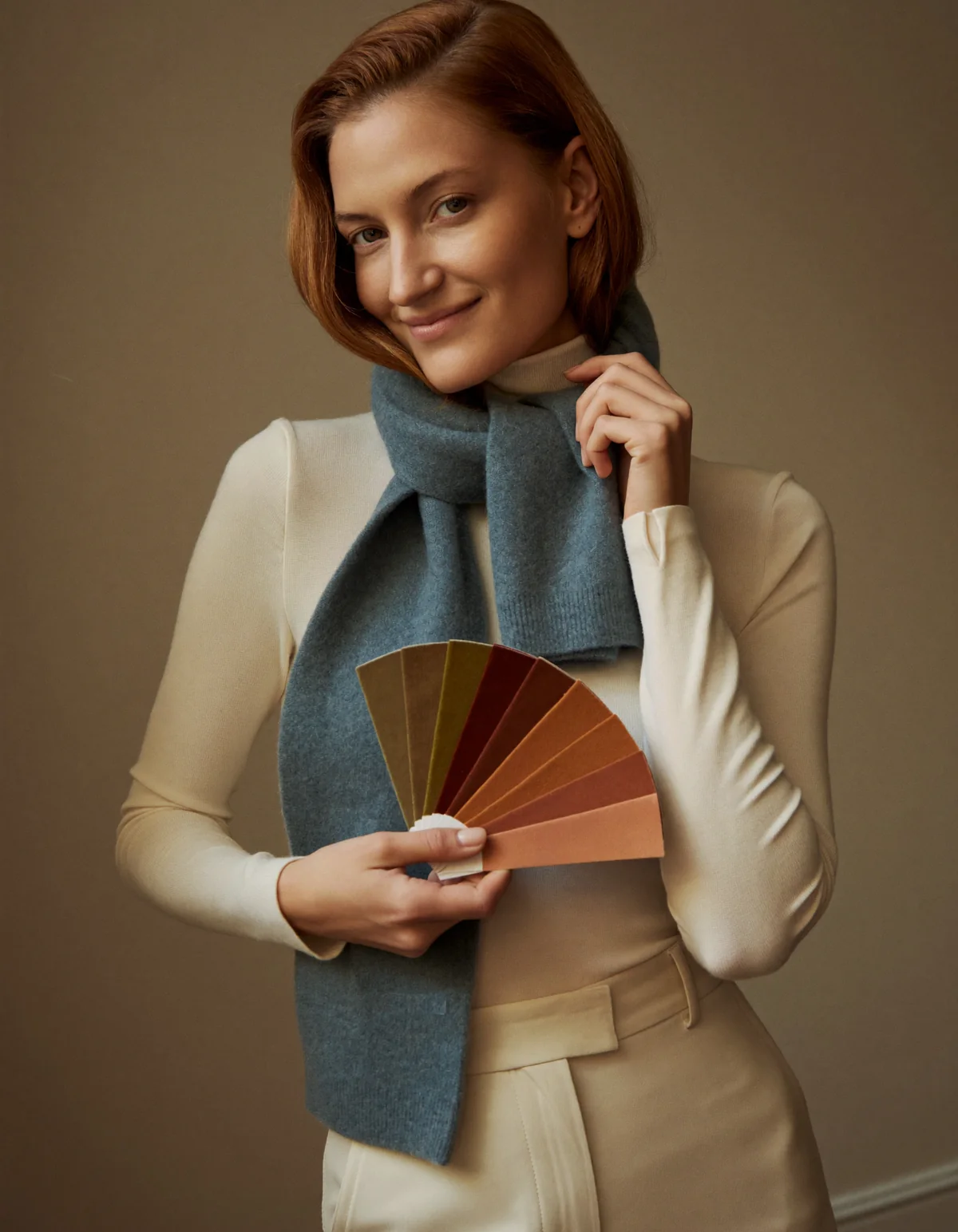
- Hold the color right under your chin, filling the frame below your face. A top, a scarf or even a towel works.
- Look at your skin, not at the fabric. Then swap in a second color and compare.
A color suits you when your skin looks smoother and more even, your eyes look clearer, and shadows under your eyes and around your mouth soften. A color does not suit you when it shows up before you do, makes your skin look gray, yellow or red, or deepens shadows and lines. Testing two colors side by side is much easier than judging one alone.
Colors that suit almost everyone
A few colors sit in the middle on all three traits, so they rarely clash with anyone. Stylists often name these as near-universal: teal, soft white (between cream and pure white), a true red that is neither orange nor blue, eggplant and soft navy. They are a safe choice for a gift, a group photo or a uniform, and a good starting point if you have not found your season yet.
What color should I wear for an occasion?
- A job interview: a neutral from your own palette, such as navy, charcoal, camel or chocolate, with one of your best colors near the face.
- Photos: a solid mid-tone from your palette. Very bright white and black lose detail on camera, and busy prints distract.
- A date or party: the brightest or richest color in your palette, worn near your face.
- A wedding guest outfit: any color from your palette except white, ivory and cream, which are traditionally the bride's. Our wedding guest dress guide has more.
Buying for someone else?
Look at what she already wears most and at the metal of her jewelry, then choose from the same family: gold-wearers usually suit warm colors, silver-wearers cool ones. A scarf or knit in one of her season's neutrals is the safest color gift. Our Christmas gift ideas for women cover the rest.
Related guides
Read next: What to Wear to a Wedding as a Guest · Black Tie Optional Dress Code for Women · Semi-Formal Dress Code for Women: What to Wear
Questions people ask about this
How do I know what colors look good on me?
Work out three things: whether your coloring is warm or cool, light or deep, and bright or soft. Together they give your color season. Then check any color by holding it under your chin in daylight and comparing it with another.
What color should I wear if I don't know my season?
Start with the near-universal colors: teal, soft white, a true red, eggplant and soft navy. They sit in the middle on undertone, value and chroma, so they rarely clash.
Do the colors that suit me change with age?
Your undertone stays the same, but hair often lightens or grays and contrast softens, so many people move toward softer or lighter versions of their palette over time.
Can I wear colors outside my season?
Yes. Wear them away from your face, in trousers, skirts, shoes and bags, or add a scarf or necklace from your palette between the color and your face.
Is black a good color for everyone?
No. Pure black flatters high-contrast and deep coloring, such as the Winter seasons, but can look harsh on light or soft coloring. Navy, charcoal, chocolate or espresso are softer dark neutrals.
What is the most flattering color?
There is no single one: the most flattering color is the one that matches your undertone, value and chroma. Teal and a true red are the closest to universal.