Permanent jewelry: what it is, what it costs, and what to know first
Permanent jewelry explained: how a welded bracelet works, the cost, which metal to choose, how long it lasts, MRIs and airports, and how to remove it.
The short answer
Permanent jewelry is a fine chain closed with a tiny weld instead of a clasp. Solid 14k gold lasts longest; gold-filled is the middle ground; skip gold-plated. Artists estimate a year or two of wear with care, longer for solid gold; snags and pool chemicals shorten it.
- It is cut off in seconds for MRIs or surgery and can be re-welded.
Permanent jewelry is a fine chain, usually a bracelet, that is sized to you and closed with a tiny weld instead of a clasp, so you never take it off. It is quick, it costs less than you might expect for silver or gold-filled chain, and it can be cut off in seconds if you need it removed. The decisions that matter are the metal, the fit and the studio. Here is what to know before you book.
How permanent jewelry works
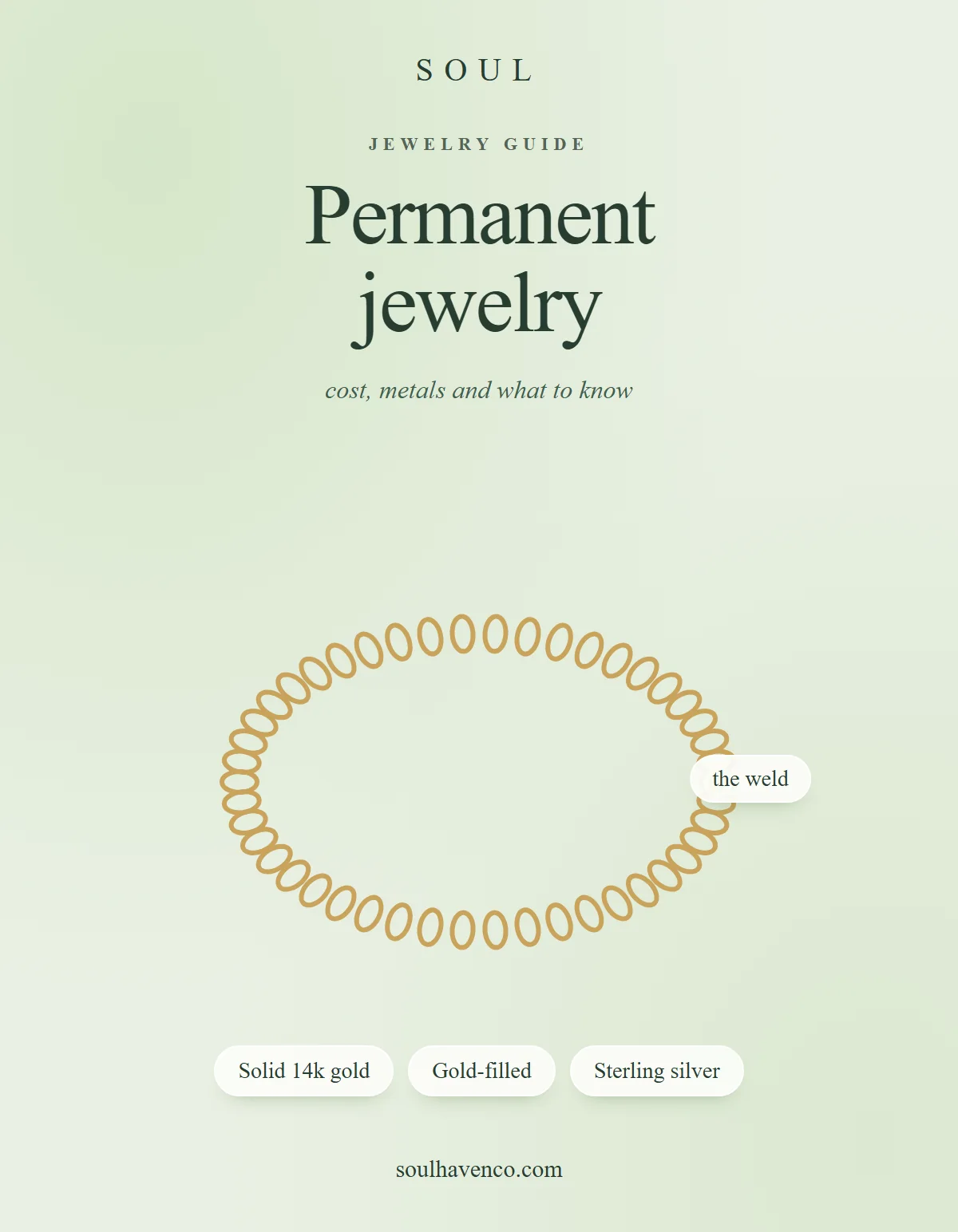
You choose a chain, the artist wraps it around your wrist or ankle and cuts it to size, and a small jump ring is welded shut with a low-energy pulse. There is no clasp, so there is nothing to open. Bracelets are the most common, followed by anklets, necklaces and rings.
What does permanent jewelry cost?
Prices depend on the metal, the chain and where you live, so ask your studio for its list. As a rule, sterling silver and gold-filled chains are the entry price, and solid 14k gold costs several times more. Some studios charge per inch of chain plus an installation fee; others price per piece. Ask whether re-welding after a removal is free or charged, because studios differ.
Which metal should you choose?
| Metal | Good for | Watch out for |
|---|---|---|
| Solid 14k gold | Wearing for years; showering, swimming and sweating | Price; still check the alloy if you react to metals |
| Gold-filled | A real layer of gold at a lower price | The gold layer can wear over a long time, more at friction points |
| Sterling silver | The lowest price; a cool, bright look | Tarnishes, especially with chlorine and sweat; needs polishing |
| Gold-plated | Short-term fashion | A very thin layer that wears through quickly; not worth welding on |
If you have a nickel allergy, ask what the alloy contains before you book.
For the differences between gold-filled, vermeil and plated, see our guide to gold vermeil vs gold-filled vs gold-plated, and for solid gold, 14k vs 18k gold. If your skin reacts to metal, read nickel allergy and jewelry first.
How long does permanent jewelry last?
A piece from Sunstone, a company that makes the welders studios use, quotes artists estimating a year or two with reasonable care, and some expecting much longer, especially for solid gold. The same article names what shortens it: snagging the chain, pool chemicals that tarnish metal, and an active lifestyle. These are artists' estimates, not tested results.
- Choose a chain that is not too fine if you lift weights, garden or have young children who grab.
- Get the fit right: loose enough to slide a finger under, not so loose it catches on everything.
- Clean it gently with mild soap and water; our guide to cleaning gold jewelry covers the safe methods.
Can you shower, swim and sleep in it?
Solid gold handles everyday water well. Chlorine and salt water are harder on silver and on the gold layer of filled pieces, so rinse after swimming. Our guide to jewelry you can shower in explains which metals cope.
MRIs, X-rays, airports and surgery
For medical imaging, studios advise cutting the jump ring or chain and having it re-welded afterward; the Sunstone article mentions X-rays, CT scans and MRIs. Hospitals may also ask you to remove jewelry for surgery. Keep the chain so it can be re-welded. Fine chains rarely matter at airport security, but follow whatever the officer asks.
How to remove permanent jewelry
Cut the jump ring, the small ring at the weld, with small scissors or nail clippers, or cut the chain itself. Removal takes seconds. Save the chain if you want it re-welded later.
Permanent jewelry ideas
- A single fine bracelet is the classic first piece and the easiest to live with.
- Stacking: two or three chains in different link styles, or mixing gold and silver if you like both.
- Anklets suit people whose wrists are always busy, but are harder on chains in shoes and socks.
- Necklaces sit at a fixed length, so choose one that clears your collarbone comfortably.
- A charm or birthstone can be added to the chain before welding at many studios.
- Matching pieces with a friend, partner or family member are a popular reason to go.
Is permanent jewelry safe?
The weld itself takes a fraction of a second and is done on the jump ring, away from your skin, usually with a protective patch underneath. The bigger questions are the metal and the fit. If you have reacted to jewelry before, choose solid gold or ask about the alloy, and skip anything with nickel. If a chain catches often, it is too loose; if it leaves a mark, it is too tight.
Choosing a studio
- Ask what the metal is and get it in writing: solid gold, gold-filled or silver, and the karat.
- Ask how they protect your skin during welding. Reputable artists use a shield between the weld and your skin.
- Ask about re-welding and whether it costs anything.
- Look at the finished welds on their own pieces: they should be small and smooth.
Read next: Gold Chain Types: How to Choose Length and Width · Gold Hoop Earrings: Sizes, Styles and How to Choose
Questions people ask about this
What is permanent jewelry?
A fine chain, usually a bracelet or anklet, sized to you and closed with a tiny weld instead of a clasp, so it stays on until you cut it off.
How much does permanent jewelry cost?
It depends on the metal and the studio. Sterling silver and gold-filled chains are the entry price, solid 14k gold costs several times more, and some studios charge by the inch plus an installation fee.
How long does permanent jewelry last?
Artists quoted by a welder manufacturer estimate a year or two with reasonable care, and longer for solid gold. Snags, pool chemicals and an active lifestyle shorten it.
What metal is best for permanent jewelry?
Solid 14k gold lasts longest and copes best with water. Gold-filled is a good middle ground. Avoid gold-plated for something you never take off.
Can I get an MRI with permanent jewelry?
Studios advise cutting it off for MRIs, CT scans and X-rays and re-welding it afterward. Follow the imaging center's instructions.
How do you take off permanent jewelry?
Cut the jump ring at the weld, or the chain, with small scissors or nail clippers. Keep the chain if you want it re-welded.