Jewelry you can actually shower in, and why “waterproof” tells you nothing
“Waterproof” has no standard behind it. What decides whether a piece survives is how thick the gold is and what sits underneath it — and water is not the thing that kills it.
“Waterproof” appears on jewelry sold at every price from fifteen pounds to fifteen hundred, which should be the first clue. There is no standard behind the word. No test a piece has to pass, no body that checks. A brand selling gold-plated brass and a brand selling solid 14k can both print it, and both are within their rights, because the term means whatever the person printing it wants it to mean.
Worse, it is answering a question you did not need answered. Water is not what kills jewelry.
What actually destroys a piece
Three things, in order of how much damage they do.
Friction
The first and largest. Plated gold is a coating measured in microns — a thousandth of a millimetre — and it wears off wherever the piece rubs. On a ring that is the underside of the band against your finger. On a chain it is every link rubbing every other link, all day. This is why a plated necklace goes patchy at the back of the neck first and why plated rings show base metal on the inside band long before anywhere else. No amount of drying it after a shower affects this at all.
Chloride
Salt water, chlorinated pools and your own sweat all carry chloride ions, and chloride attacks the base metal underneath through any microscopic pore in the plating. The plating does not have to have visibly worn through for this to start. This is the mechanism that turns skin green: it is the base metal reacting, not the gold, and it happens fastest in exactly the conditions brands describe as “swim-proof.”
Soap film
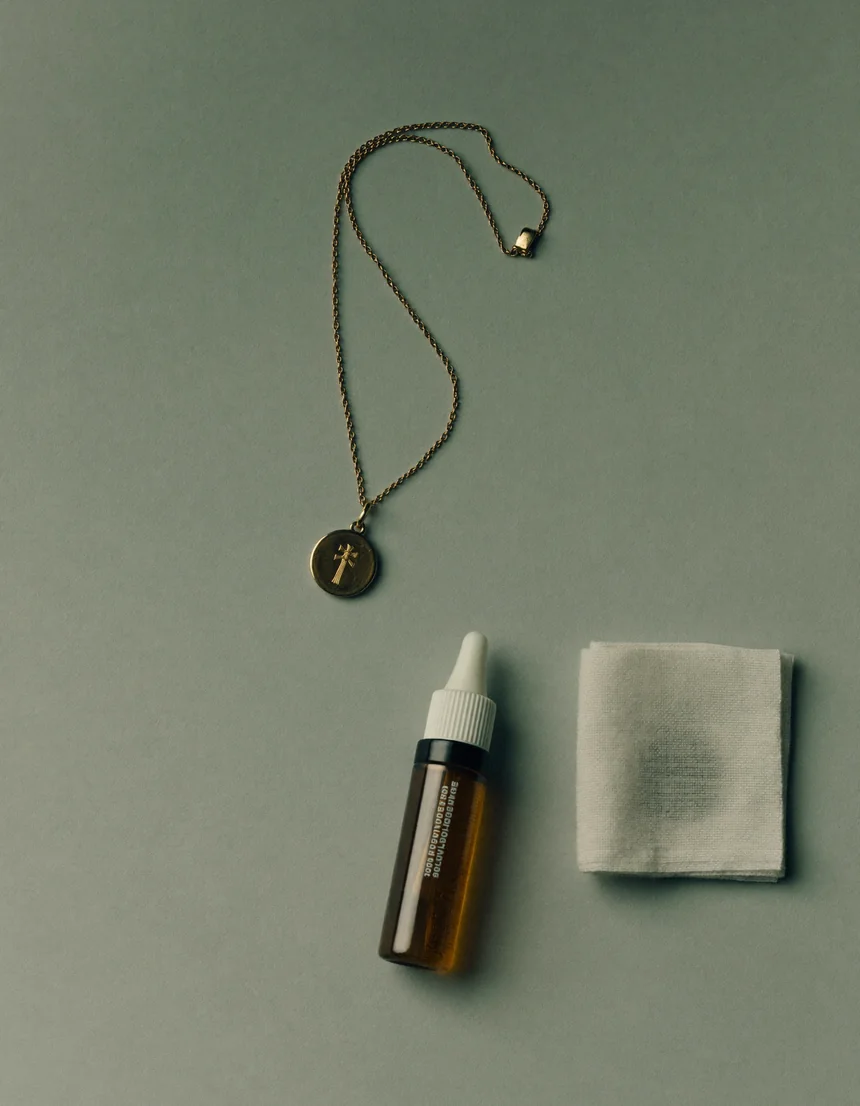
The least serious and the most commonly misdiagnosed. Shower gel and shampoo leave a dulling residue on solid gold that reads as tarnish and is not — it is a film, it buffs off with a soft cloth, and it has done no harm. People throw away perfectly good chains over this.
The only spec that matters
How much gold is there, and what is underneath it. Four tiers, and the gap between them is larger than the marketing suggests.
| How long it lasts | Shower in it? | What gives first | |
|---|---|---|---|
| Solid gold, 10k–18k | Indefinitely | Yes | Nothing — friction just polishes it |
| Gold-filled | Years of daily wear | Yes | The bonded layer, at rub points, eventually |
| Vermeil | Roughly one to three years | Occasionally | Coating thins; the silver beneath tarnishes |
| Plated | Months | Not really | Coating wears through; base metal reacts |
“Waterproof” appears on products in all four rows. It is not a material property and no standard sits behind it.
Solid gold, 10k to 18k. Gold all the way through. There is no layer to wear off, so friction just polishes it. It does not tarnish. Higher karat is softer and scratches more easily, which is why 14k is usually the better choice for something worn daily — the reasoning is in 14k vs 18k gold. This is the only tier that is genuinely indifferent to water.
Gold-filled. A thick layer of gold mechanically bonded to a base, and in the US the layer has to be at least 1/20th of the total weight to be called that. It is roughly a hundred times the gold of plating, and it lasts years of daily wear. This is the tier most people should be buying and almost nobody asks for by name.
Vermeil. Sterling silver base with at least 2.5 microns of 10k or better over it. Better than plating, and the base is silver rather than brass, so when it does wear you get tarnish rather than green skin. It will still wear.
Plated. Can be half a micron. Months, not years. Fine for something you wear occasionally and expect to replace; a poor choice for the piece you never take off, regardless of what the product page says about showering.
So what can you actually shower in?
Solid gold: yes, endlessly, and the dullness is soap film. Gold-filled: yes, and it will still be fine in three years; rinse the chlorine off after a pool. Vermeil: you can, but every shower spends a little of a finite coating. Plated: it is not the water, it is that you are wearing it daily — that is what uses it up.
Two things worth knowing whatever you own. Take rings off for the gym, because friction under grip load does more damage in an hour than a month of showers. And put jewelry on last, after perfume and lotion, because the alcohol and oils sit in the pores of plating and hold chloride against the base.
Buying, in one question
Ask what it is made of, and treat a product page that says “waterproof” without saying solid, filled, vermeil or a karat number as having answered no. Brands that sell solid gold say so in the first line, because it is the expensive part and they want credit for it. Vagueness is a pricing decision.
The same checks that tell real gold from plated work on something already in your drawer — a hallmark, the weight in the hand, and what the inside of the band looks like after a year.
Questions people ask about this
What does waterproof jewelry actually mean?
Nothing standardised. There is no test a piece must pass and no body that verifies it, so brands selling thin plating and brands selling solid gold can both print the word. The useful question is what the piece is made of — solid, gold-filled, vermeil or plated — because that is what decides how long it survives.
Can you shower in gold-plated jewelry?
You can, but showering is not what wears it out. Plating is a coating measured in microns and friction removes it — the underside of a ring band, the back of a chain. Daily wear is what uses it up. Chlorine and sweat accelerate it by attacking the base metal through pores in the coating.
Why does my jewelry turn my skin green?
That is the base metal reacting, not the gold. Chloride from sweat, salt water or pool water reaches the brass or copper underneath through microscopic pores in the plating and the reaction transfers to skin. Solid gold cannot do this because there is no other metal in the piece to react.
Is gold-filled jewelry good for everyday wear?
It is the best value tier for it. US gold-filled must be at least 1/20th gold by weight — roughly a hundred times the gold in plating — mechanically bonded rather than deposited, and it holds up to years of daily wear. Most people looking for waterproof jewelry actually want gold-filled and do not know to ask for it by name.
Does solid gold tarnish?
No. The dullness people mistake for tarnish on solid gold is soap and lotion film, which buffs off with a soft cloth and has caused no damage. Sterling silver genuinely does tarnish, by a different mechanism — a sulfur reaction — which is why a vermeil piece behaves differently from a plated-brass one once the coating thins.