LED or UV nail lamp? Watts, cure times and what actually matters
The wattage on the box is not the whole story. How to match a lamp to your gel, why thumbs cure alone, and what the 2023 nail lamp study did and did not find.
The short answer
LED and dual LED/UV lamps cure most modern gels in 30–60 seconds; old UV tubes take about two minutes.
- LED and dual LED/UV lamps cure most modern gels in 30–60 seconds; old UV tubes take about two minutes.
- Advertised wattage is unreliable: use the lamp your gel system specifies.
- Cure every coat for the full stated time, thumbs on their own, with thin coats.
- Both kinds emit UV-A: protect the backs of your hands with SPF 30+ or fingerless gloves.
The lamp is the part of an at-home gel kit people spend least on, and it quietly decides how long every set lasts. A gel that is not fully cured stays soft underneath, dents, wrinkles and lifts — and the polish gets the blame. Choosing well comes down to three questions: which kind of light your gel needs, how much the number on the box really tells you, and how to cure each coat properly.
LED, UV or both
Both kinds of lamp cure gel with ultraviolet and near-ultraviolet light. The difference is the light source. Older UV lamps use fluorescent tubes that give off a broad range of UV-A and usually need around two minutes a coat. LED lamps use light-emitting diodes that concentrate their output in a narrower band, roughly 365 to 405 nanometers, which is why many modern gels cure in 30 to 60 seconds under them. Most current lamps are dual, carrying LEDs at more than one wavelength so they cure a wider range of gels.
| LED | UV (fluorescent) | Dual LED/UV | |
|---|---|---|---|
| Typical cure per coat | 30–60 seconds | About 2 minutes | 30–60 seconds |
| Gel compatibility | Gels formulated for LED | Most traditional gels | The widest range |
| Bulbs | Long-lived, not replaced | Tubes dim and need replacing | Long-lived |
| Best for | A single LED gel system | Older gel stock | Most people starting out |
The only rule that always holds: use the kind of lamp your gel's maker says it is designed for.
What the wattage on the box means
Wattage is the number every listing leads with, and it is the least reliable one. It describes how much power the lamp draws, not how much curing light reaches your nail, and many budget lamps advertise a figure well above what they actually use. What matters is the light that reaches the nail at the right wavelength for long enough.
In practice: choose a lamp your gel system specifies or says it works with. Many at-home gels are designed for LED lamps in roughly the 36 to 48 watt class, and a genuinely weak lamp is a common cause of soft, lifting sets. If your gel cures properly in the stated time, your lamp is fine, whatever the box says.
How long to cure each coat
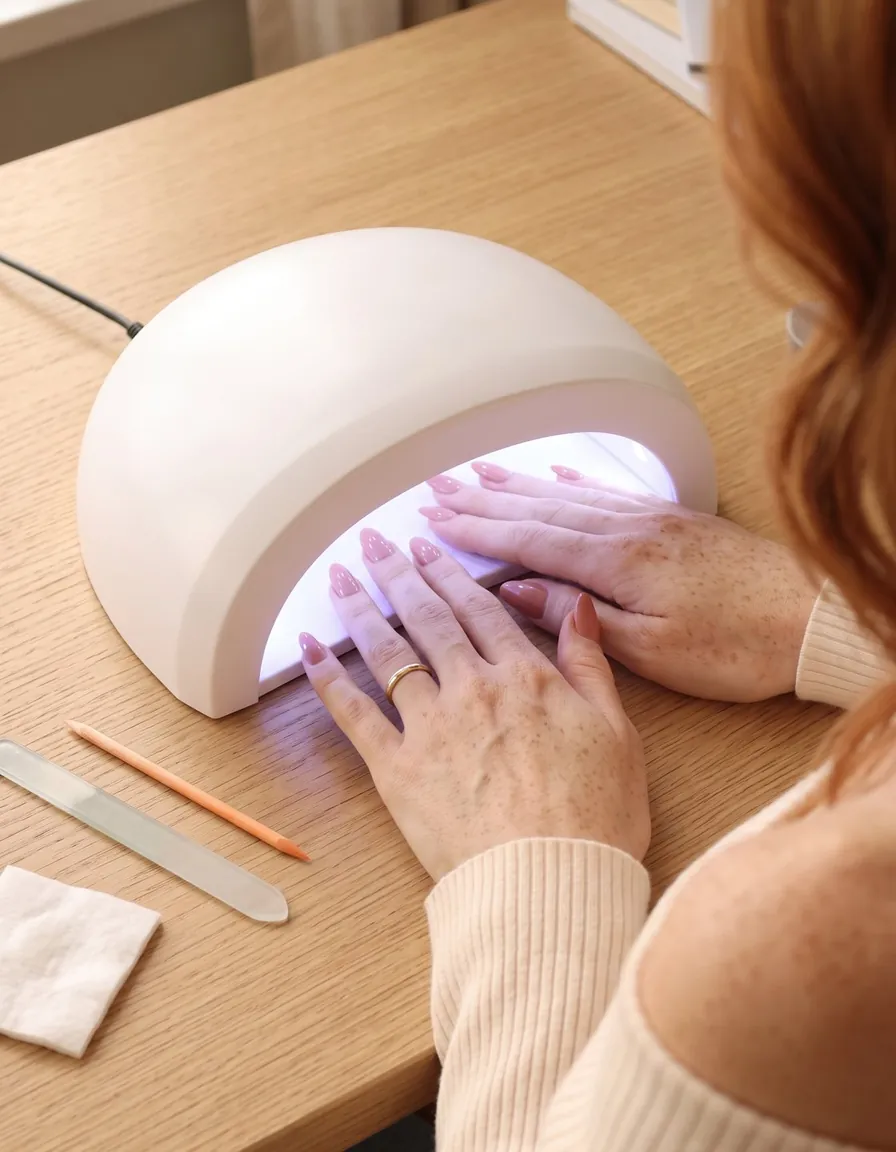
Use your gel’s own cure time, every coat, even when the surface already looks done: the surface cures first and the gel underneath last. A few habits make a real difference:
- Hands flat, nails fully inside the light, not peeking from the edge where the light is weakest.
- Thumbs on their own. A thumb lies at an angle beside the fingers and cures unevenly. Do four fingers, four fingers, then both thumbs together.
- Thin coats. Light only penetrates so far; thick gel stays soft at the bottom however long you cure it.
- Feel a burst of heat? That is a thick layer curing fast. Slide out for ten seconds, then back in, and use a thinner coat next time.
If a set wrinkles or dents after curing, our guide to why gel nails lift and wrinkle walks through the causes.
Is the light safe?
Nail lamps of both kinds give off UV-A. A 2023 laboratory study published in Nature Communications found that light from a UV nail dryer damaged DNA in human and mouse cells grown in a dish. It did not measure risk in people, and the authors called for more research, but it is a reasonable prompt to protect your skin. The American Academy of Dermatology suggests a broad-spectrum SPF 30+ on your hands before a gel manicure; fingerless gloves that leave only the nails exposed are a simple alternative. Exposure also scales with how often you do sets, which is one more reason to cure only as long as your gel needs.
What to look for when you buy
- Compatibility first: a lamp your gel’s maker recommends or lists as compatible.
- Timer presets that match your gel’s cure times, usually 30, 60 and 90 or 120 seconds.
- Room for a whole hand, with enough space to lay the thumb flat on its own.
- A removable or open base, which makes curing toes possible and cleaning easy.
- An auto sensor that starts when your hand goes in: small, but it makes a long session easier.
Our At-Home Gel Edit includes a session timer that counts each cure in the right order — fingers, fingers, thumbs — and a journal page for your lamp and cure times, so you never have to guess halfway through a set.
Questions people ask about this
Is an LED or UV nail lamp better?
Use whichever your gel is formulated for. LED and dual LED/UV lamps cure most modern gels in 30 to 60 seconds a coat and do not need bulb replacements, which is why most people starting out choose a dual lamp.
What wattage nail lamp do I need for gel polish?
Choose a lamp your gel system specifies. Many at-home gels are designed for LED lamps in roughly the 36 to 48 watt class, but the advertised wattage matters less than whether the gel fully cures in its stated time.
How long should I cure gel nails under an LED lamp?
Use your gel's stated cure time for every coat, often 30 to 60 seconds under a matched LED lamp. Cure thumbs separately, and keep coats thin.
Do LED nail lamps give off UV?
Yes. Nail lamps sold as LED still emit UV-A, typically around 365 to 405 nanometers, because that is the light that cures the gel.
Are nail lamps safe?
A 2023 lab study found UV nail dryer light damaged DNA in cells in a dish; it did not measure risk in people. Dermatologists suggest broad-spectrum SPF 30+ on the hands or fingerless gloves during a gel manicure.