Outfit formulas: how to stop deciding what to wear from scratch every morning
A formula is an outfit you only decide once. How to write your own from clothes you own, twelve that work in most closets, and why repeating is the point.
The short answer
An outfit formula is a combination you decide once and repeat, changing one piece to suit the day.
- An outfit formula is a combination you decide once and repeat, changing one piece to suit the day.
- Write formulas by role: top, bottom, shoe, layer and an optional finish.
- Two neutrals plus one accent keeps any top compatible with any bottom.
- Check shoes, weather and a laundry swap before a formula goes into rotation.
An outfit formula is an outfit you only decide once. Instead of standing at the wardrobe building a look from nothing, you reach for a combination you already know works — shirt + straight trousers + clean trainers — and change one piece to suit the day. It sounds almost too simple. It is also how most people who always look put-together actually get dressed.
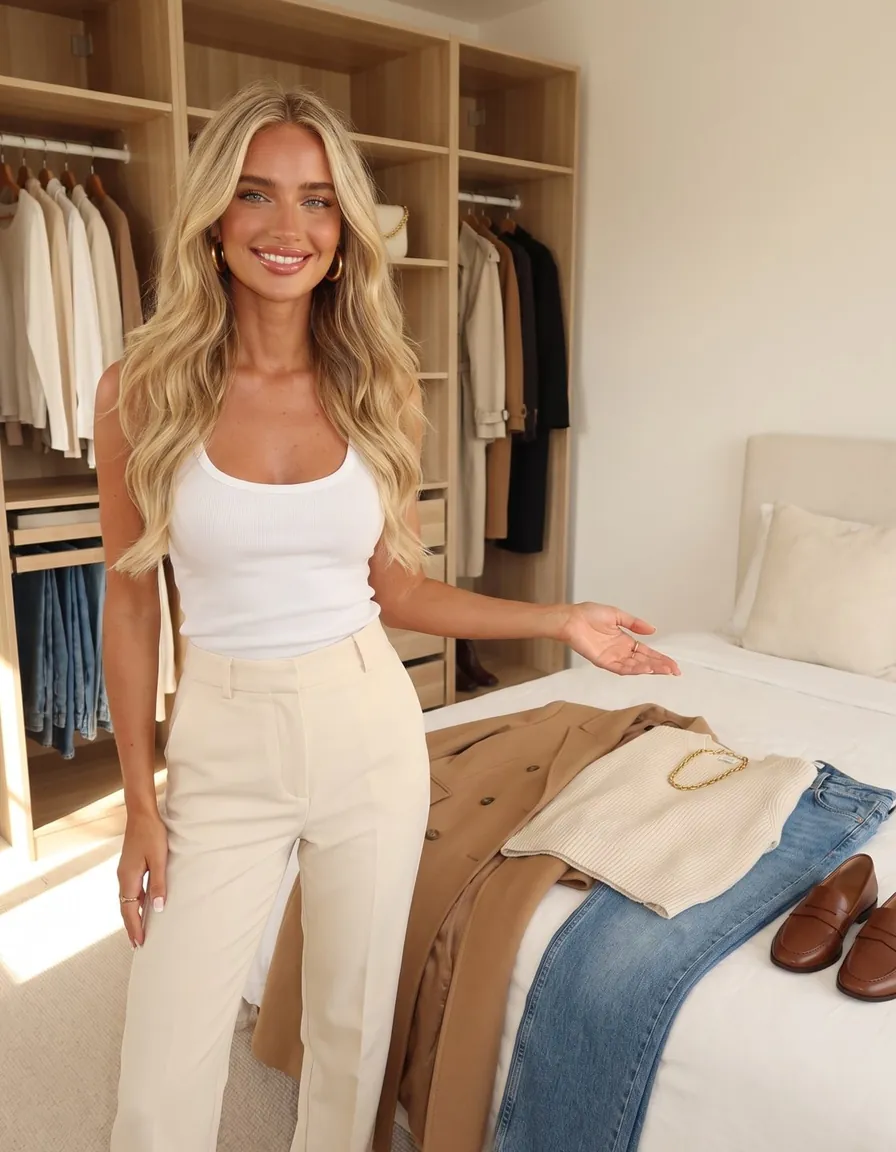
Camille, SOUL’s style host, pictured here with one of her formulas laid out on the bed, likes to put it this way: a formula is not a uniform. It is a decision you get to stop re-making.
Write a formula by role, not by item
The trick is to write each formula as roles rather than specific garments. A role is the job a piece does: top, bottom (or a one-piece), shoe, layer and, optionally, finish — a bag, a belt, a gold chain. “Crisp top + tailored bottom + clean flat shoe” can be made from a dozen different pieces you own, which is exactly why it keeps working.
Then write your own version precisely. “Ivory shirt, sleeves rolled, navy trousers, white trainers” is far more useful at 7:40 in the morning than “smart casual.”
Twelve formulas that work in most closets
These are starting points. Swap any piece for one that does the same job for you: a skirt can become trousers, a tank can become a higher neckline, trainers can become loafers.
| Formula | Built from | Good for |
|---|---|---|
| The desk day | Crisp shirt + straight trousers + clean trainers | Office, errands after |
| The travel day | Striped top + straight jeans + cardigan over the shoulders | Trains, planes, long sits |
| The easy dinner | Fine knit + midi skirt + flat sandals or boots | Dinner, drinks |
| The meeting | Fitted tank or tee + tailored trousers + blazer | Presentations, interviews |
| The long lunch | Simple dress + light layer + walking shoe | Lunch with a walk |
| The coat formula | Cream knit + straight jeans + camel coat + loafers | Autumn to early spring |
| The weekend | Soft knit + jeans + ankle boots | Markets, coffee, errands |
| The one-and-done | Shirt dress + belt + trainers | Days with no time |
| The tonal look | Cream top + cream trousers + one gold piece | When you want to look expensive |
| The contrast | Slip skirt + oversized knit + trainers | Casual days that still feel dressed |
| The easy proportion | Wide trousers + fitted tee + mules | Warm days |
| The cold day | Dress + opaque tights + boots + long coat | Winter evenings |
Pick three you would genuinely wear this week. Twelve is a menu, not homework.
Keep the colors doing the work
Formulas stay flexible when your colors agree with each other. The simplest rule is two neutrals you like together plus one accent: navy and ivory with camel, or grey and white with sage. You do not need a seasonal color analysis for this. You only need most of your pieces to go with most of your other pieces, so any top can meet any bottom.
If a print is involved, pull one color out of it and repeat it somewhere else in the outfit — the shoes, the bag, a layer. That single repeat is what makes a look feel intentional.
Make each formula survive a real day
A formula earns its place by surviving ordinary life. Before it goes into rotation, check it three ways:
- Shoes first. Choose the shoe for the route before anything else. An outfit you cannot walk in is not an outfit yet.
- Weather second. Name the layer that goes over the whole thing, and check the base still fits comfortably under your real coat.
- Laundry third. Name a swap for the piece most likely to be in the wash. That swap is what keeps the formula working on the busiest day of the week.
Repeating is the point
People worry that formulas will make them look the same every day. In practice nobody notices repetition the way we imagine they do, and changing a single element — the shoes, the layer, the finish — makes the same formula read as a different outfit. The payoff is a morning with one small decision in it instead of twenty.
It also changes how you shop. Once you know your formulas, a new piece has to fit into at least two of them before it earns a place, which quietly ends most impulse buys. Our note on cost per wear takes that idea a step further.
Our Wear-Again Edit includes fourteen formulas like these as printable cards, plus a planner to put them across two weeks. The formulas above are free to use either way.
Questions people ask about this
What is an outfit formula?
A repeatable combination written by role, such as crisp top + tailored bottom + clean flat shoe. You decide it once, then fill it with whichever of your pieces suits the day.
How many outfit formulas do I need?
Three or four cover most weeks. Start with the ones you already wear happily and write them down precisely, including the shoes.
Will I look the same every day?
Not if you change one element, such as the shoes, the layer or the finish. Most people notice repetition far less than we expect.
How do I make my own outfit formula?
Take an outfit you love, name each piece's role (top, bottom, shoe, layer, finish), then list which other pieces you own could fill each role.
Do outfit formulas work with a big wardrobe?
Yes. The formula narrows the choice for the morning; it does not limit what you own. A large wardrobe simply gives each role more options.